
Hitman - World of Assasins Review
A bald man, a barcode, and 1,000 creative ways to ruin a vacation: why Hitman is the ultimate murder sandbox.
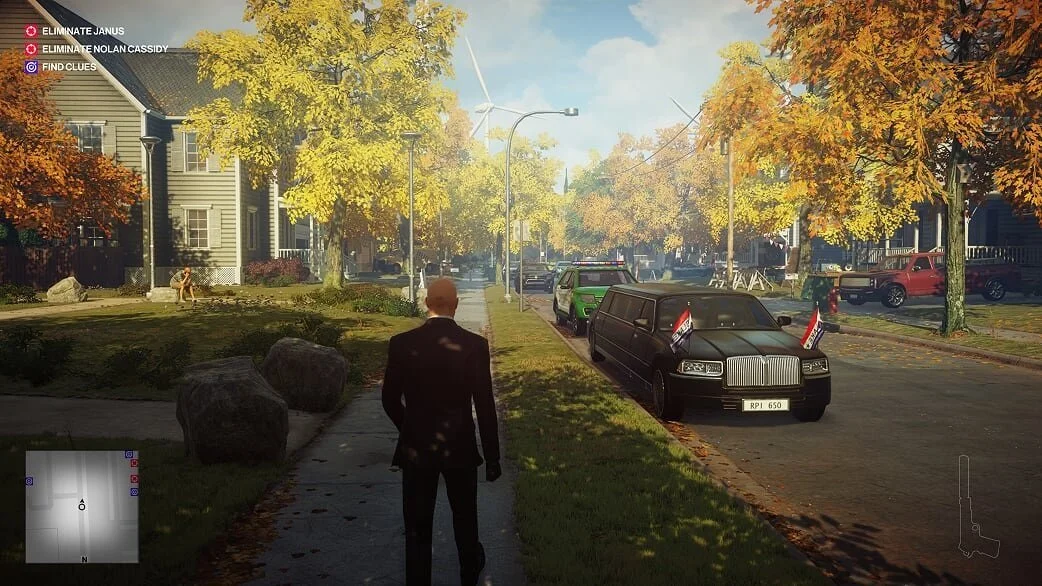
The Hitman cinematic universe has quietly been in development for nearly a decade. It is centered around three main games and a steady stream of bonuses, from escalation contracts to elusive targets. At the center is Agent 47, the stoic leading man and star of the show. Each mission is a new stage, and every disguise is a new role: chief surgeon, hippo whisperer, sushi chef, race mechanic, and many others. Armed with a toolbox of gadgets and weapons, our charlatan assassin slips into these personas. He uses them to access new conversations, restricted areas, and unique assassinations through events tailored to each level.
The three games offer self-contained sandboxes that let players control how the narrative unfolds. You pick the disguise, route, and execution method, while the level's system responds accordingly. The result is a dense playground filled with stories that encourage exploration.
The trilogy opens with a sequence of high-profile contracts that gradually expose a larger conspiracy within the agency, drawing Agent 47 into a personal vendetta against his creators and betrayers. The narrative spans diverse locations, from the cliffside village of Sapienza to the skyscrapers of Dubai, with each setting serving as a new stage for assassination that advances both immediate objectives and the overarching web of corporate intrigue and family secrets. The storyline emphasises sandbox gameplay over extensive exposition, allowing players to focus on the assassinations while the underlying conspiracy develops in the background.
Favourite Mission
A perfect showcase of the game's unique and compelling environment is the Finish Line set in Miami during a chaotic “Global Innovation” race weekend that doubles as a tech expo. You are tasked with eliminating Robert and Sierra Knox, a father and daughter whose mutual disdain is a tool at your disposal.
The methods I chose focused on taking over a blackmail plot by a former employee to secure an isolated confrontation with Sierra and on becoming a race mechanic to sabotage Robert’s concept car, with explosive consequences.
In both cases, I followed the mission stories almost exactly as presented. They worked, but they also left me with a lingering sense of what might have been. As I wandered through the expo after eliminating each target, new opportunities kept revealing themselves, but with the targets already eliminated, I was unable to pursue them. That same feeling carried over into other missions as well, where I often felt that there were more creative or entertaining solutions I had missed. Eventually, that intrigue pushed me to start creating manual saves at key decision points, just so I could rewind and see how differently the same contract might unfold. It’s this creative level design that makes you feel like no level is truly solved.

Negatives
One of the few moments where Hitman’s immersion dips is in how the world responds to the detection of suspicious behaviour. At the point of detection, the mechanics are excellent: guards and civilians notice suspicious behaviour, outfits are compromised when you're seen committing a crime in them, and witnesses actively raise the alarm. However, once the dust settles, the simulation quietly snaps back into place. Targets who probably should run from the map rarely do, co conspirators rarely react to their partners' sudden disappearance, and most NPCs eventually revert to their routines as if nothing happened.
It is possible to leave a trail of bodies, hide in a wardrobe, change into a different outfit, and be treated as just another stranger, which undermines the otherwise brilliant feeling of a living, reactive sandbox.
Conclusion
The pure freedom to experiment, combined with narratives that you can shape yourself, elevates Hitman above most other stealth games in the genre. Each level feels alive and never fully solved, rewarding players who are curious enough to explore different approaches or replay key moments. While the game doesn’t give much weight to mistakes, this rarely detracts from the overall experience, as the focus on observation, creativity, and choice more than makes up for it. It’s this combination of freedom and clever level design that keeps the trilogy engaging long after the main story is completed. Overall, we have given the Hitman trilogy a 9.5, as it provided a sandbox-style stealth gameplay that sets the standard for the genre.
Employability Score
The structure of Hitman makes it perfect for dipping in and out. Instead of treating each game as a separate campaign, it's better to think of the three modern Hitman titles as a long-running series, with each mission as an episode. You can jump into Marrakesh, Miami, or Berlin on any given night, run a single contract, and step away satisfied without needing to re-absorb a 30 hour narrative.
That same structure is exactly why Hitman earns a perfect Employment Ratio here. Missions are self-contained, the overarching plot is easy to follow but never demanding, and the saving system is generous enough to let you experiment freely and roll back bad ideas. Replayability is built in: finishing a level once almost always reveals new routes, disguises, and assassination setups that practically dare you to come back. Three difficulty options, including modes with unlimited saves, let everyone from curious newcomers to seasoned assassins find a setting that fits both their skill and their schedule.